
Excellences,
Dear Colleagues,
Ladies and Gentlemen,
The surge in terrorist attacks in the Middle East, Africa and Europe provides now, more than ever before, proof that terrorism has evolved into a major global threat, which calls for decisiveness and coordinated efforts by the entire international community, in order to be successfully countered in all its forms and manifestations.
Τhe recent attacks of ISIS and its affiliates in different parts of our neighbourhood demand that we act urgently, collectively and in a comprehensive manner. This means that ISIS shall not be defeated without the contribution of all countries –to the extent of the possibilities of each one of them- and particularly of the countries of the Mediterranean region.
In dealing with violent extremism, radicalization and the phenomenon of foreign terrorist fighters, it remains of fundamental importance to uphold human rights and the rule of law. Counter-terrorism measures should focus on prevention by addressing the root causes of this scourge. We also need to foster tolerance and non-discrimination, mutual respect and understanding in our societies.
In the short and medium terms, fighting ISIS involves more than the use of military means. We need to equally address many aspects, such as its financing, the appeal of its extremist ideology, as well as the recruitment of foreign terrorist fighters. In order to be successful, we need to further enhance our cooperation within relevant international and regional organizations.
The increasing flow of foreign terrorist fighters constitutes a common threat to the countries of the Mediterranean region and not only, a threat that demands effective cooperation between states. Information sharing and exchange of best practices are essential in our efforts to counter this asymmetric threat. In this context, we should focus on the best use of existing tools, but also on our efforts to increase the interoperability of our information systems and the reduction of relevant gaps.
In particular, the countries of the Mediterranean region can, due to their geographical position, contribute substantially to the international endeavor to defeat terrorism. To this end, strengthening border security constitutes an important parameter, which needs to be tackled effectively, taking into consideration that border control and management remains, primarily, a national responsibility. My country, with more than 121 official border-crossing points is determined to continue contributing to the internal security of our entire region.
Greece has constantly expressed its full support to the international mobilization against terrorism and participates in these efforts at bilateral, regional and multilateral levels. Responding to the urgent need for collective action, my country lends its political support to the Global Coalition against ISIS and actively participates in the Coalition’s Working Group for the stabilisation of territories recuperated from ISIS in Iraq.
As I previously mentioned, terrorists should be prevented from exploiting any resources to incite financial support for their actions. Therefore, Greece supports the inclusion of trafficking of archaeological objects obtained through looting or illegal excavations in Syria and Iraq into the counter-terrorism agenda, as these activities, according to UNESCO, contribute substantially to the financing of terrorist groups.
We are particularly preoccupied over the humanitarian crisis that has caused immense suffering and displacement of millions of people in the region. Attention should also be brought to the fate of minority communities, including Christians, who face an existential threat, due to the atrocities perpetrated against them by ISIS.
Greece supports interfaith dialogue, since it contributes to the peaceful coexistence among people of different cultural and religious backgrounds. Two relevant Conferences were organized in Athens under the auspices of the Hellenic Ministry of Foreign Affairs, last September and October: an interfaith dialogue meeting between Christian and Muslim religious leaders and an interfaith Christian-Jewish colloquium. Furthermore, last October we hosted, in Athens, an International Conference on “Religious and Cultural Pluralism and Peaceful Coexistence in the Middle East”, with the participation of various religious leaders and political figures from the Christian, Jewish and Muslim world.
Ladies and Gentlemen,
Greece has been disproportionately burdened during the last months, by an unprecedented flow of refugees and migrants, which threatens to evolve into a humanitarian disaster.
Our immediate concern is to stem and manage the extraordinary mixed migratory flow. We did and continue to do our utmost to rescue refugees fleeing from war, while they struggle in their flimsy boats in the Aegean Sea, rescuing so far more than 90.000 people in over 2.500 incidents. We have put tremendous efforts to rescue those people in need and receive them in a humane way in our frontline islands, with the aid and mobilization of the local population.
However, in order to be effective, the international community needs to complement short term measures by a long term comprehensive strategy dealing with all aspects of the issue, including the dismantling of trafficking networks and, most importantly, the adoption of solidarity-driven actions and responsibility-sharing. Above all, we firmly believe that without addressing the root causes of this phenomenon, there is no prospect for the return of the refugees to their homelands.
Ladies and Gentlemen,
In closing, please allow me to reiterate that enhancing the cooperation within our Mediterranean neighbourhood and deepening our dialogue are essential conditions for the efficiently tackling of the emerging security challenges and threats.
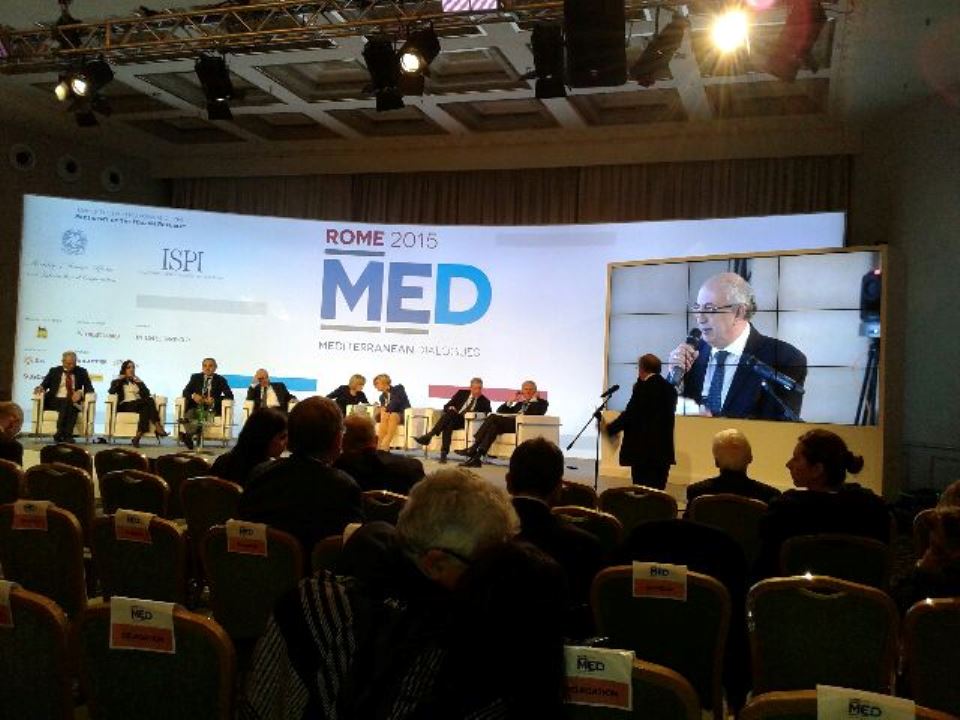
Therefore, I wish to congratulate and thank the Italian Institute for International Political Studies for organising this highly interesting and fruitful Conference.
Thank you for your attention.


